

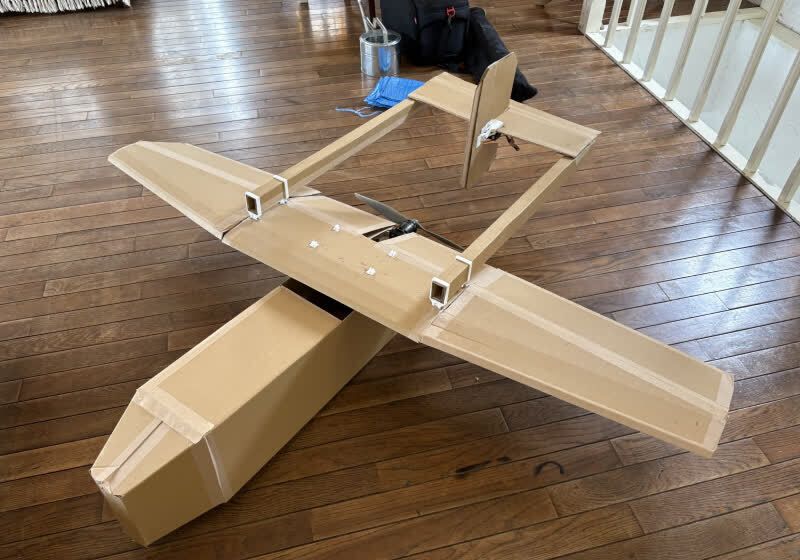
AirKumay Launches “150” Cardboard Drone, Advancing Sustainable Aerial Logistics
AirKumay has unveiled its latest innovation—the “150” cardboard drone—marking a notable step forward in the convergence of lightweight packaging materials and unmanned aerial logistics.
Designed for short-range delivery and rapid deployment scenarios, the AirKumay 150 leverages engineered corrugated fibreboard as a primary structural component. The drone is capable of carrying payloads of up to 1.5kg over distances of approximately 50km, offering a low-cost and environmentally conscious alternative to conventional UAV platforms.
The use of fibre-based materials significantly reduces overall weight while enabling simplified manufacturing and end-of-life disposal. Unlike traditional composite or metal drones, the cardboard-based structure can be produced using widely available converting technologies within the pulp and paper value chain, opening new opportunities for cross-industry collaboration.
According to AirKumay, the 150 model is particularly suited for applications in humanitarian aid, rural logistics and last-mile delivery in regions with limited infrastructure. Its flat-pack design allows for efficient transportation and on-site assembly, further enhancing operational flexibility.
From a sustainability perspective, the AirKumay 150 aligns with growing industry efforts to reduce carbon footprints and material waste. Fibre-based components are renewable, recyclable, and in some cases biodegradable, reinforcing the role of paper-based materials beyond traditional packaging applications.
The launch reflects a broader trend of material innovation within the pulp and paper sector, where corrugated solutions are increasingly being engineered for high-performance, non-traditional uses. As industries explore alternatives to plastics and heavier materials, solutions such as the AirKumay 150 demonstrate the expanding functional scope of fibre-based design.
With pilot deployments expected in selected markets, AirKumay’s latest development underscores the potential of paper-based technologies to support emerging logistics ecosystems while contributing to circular economy goals.
