

Paper Production, Felt Age and Vacuum System Design
By Manfred Dobler, Head of Paper Industry at Everllence
As press felts age, airflow and vacuum requirements for effective dewatering change significantly. Understanding this relationship is essential for consistent sheet dryness, process stability and efficient paper, board and tissue production.
Consistent sheet dryness in high-speed paper, board and tissue machines depends on removing a constant volume of water. As felt permeability changes throughout its service life, the relationship between vacuum and airflow also changes. An inherent mismatch between these requirements in many conventional vacuum systems, combined with slot geometry and limited extraction time, can reduce dewatering efficiency and affect sheet dryness, machine speed and quality consistency.
This article examines how changes in felt permeability influence dewatering requirements and explores why independently adapting airflow and vacuum supports consistent papermaking performance in modern high-speed paper machines.
With lengths reaching one hundred metres, widths exceeding 10 metres and speeds approaching 120km/h, modern paper, board and tissue machines operate near physical and mechanical limits. A single machine can produce hundreds of thousands of tonnes annually, so small inefficiencies in water removal can cause quality issues, higher energy use and lost production time. Felt-press dewatering is therefore a critical stage of papermaking.
Unlike direct dewatering such as nip-dewatering, indirect dewatering transfers water from the paper into a felt and then extracts it using vacuum. This two-step process is key to product dryness at the press section exit and strongly influences drying energy demand. Yet the physics of felt dewatering and its interaction with vacuum system design are often misunderstood.
x-head: The role of felt permeability and age
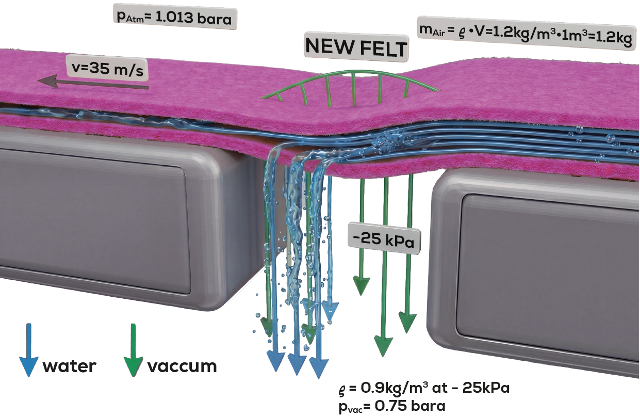
Press felts, typically replaced every six to 12 weeks, change throughout their lifecycle. A new felt has relatively high permeability, with large interconnected voids allowing air and water to pass with little resistance.
Typical permeabilities are 18 – 30 cubic feet per minute (CFM) for tissue machines and 60 – 80 CFM for cardboard machines. Continuous compression, repeated bending over machine rollers and large pressure differentials gradually compact the felt and reduce pore sizes. Additionally, fibres and fillers (such as CaCO3) also accumulate unevenly, reducing permeability over its operational life.
For a given pressure differential, airflow decreases as the felt ages and permeability declines. Extracting the same amount of water from an older, compacted felt therefore requires a larger pressure differential and higher vacuum.
Consistent product quality requires the same amount of water to be removed regardless of felt age. Vacuum conditions must therefore adapt continuously as permeability changes over the felt lifecycle.
Vacuum extraction also occurs within a very short time at high machine speeds. In suction, dewatering or Uhle boxes, water is drawn through slots typically 10 – 15mm wide. Wider slots increase residence time but can draw the felt too deeply into the opening, causing sharp bending at the edges, felt damage or thermal degradation. Narrower slots may not allow enough time for water to migrate through the felt. Effective drainage therefore requires a balance of slot width, felt permeability, vacuum and machine speed. As permeability decreases, the required operating point shifts from high airflow and relatively low vacuum with a new felt, to lower airflow and higher vacuum with an older felt. A system unable to adjust these variables independently will struggle to maintain consistent dewatering. This is further complicated when several Uhle boxes and felt loops of different ages share a small number of vacuum pumps. Within each slot passage, the pressure difference rises as the felt enters the vacuum zone and falls as it leaves. Too little vacuum leaves water in the felt, while excessive vacuum increases wear without a proportional dewatering benefit. Modern machines add a further complication because several Uhle boxes and felt loops may share only a few vacuum pumps, while the felts are seldom replaced simultaneously. The common system must therefore accommodate suction points with different permeability, airflow and vacuum requirements at the same time. Drainage through each slot is also transient rather than constant, making accurate coordination of geometry and operating conditions essential.
x-head: The challenge of pump limitations
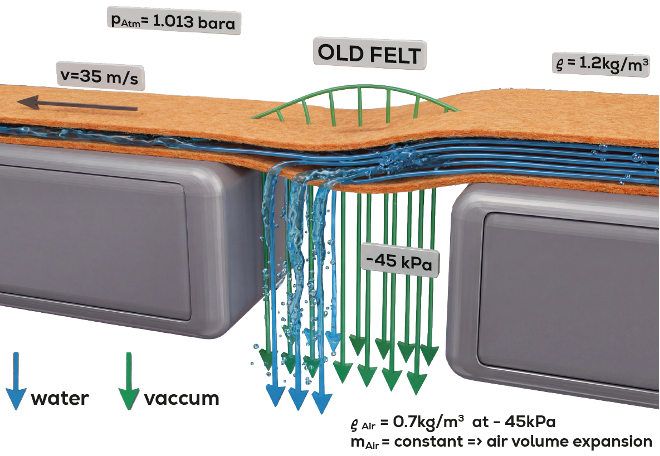
Consistent quality and efficient operation require control of both vacuum and airflow. Their relationship can be illustrated by comparing air density at different pressure levels.
- Atmospheric air at 1.013 bar (101.3 kPa) has a density of 1.2kg/m3
- Air in the Uhle box with a new felt at a vacuum level of approximately 25 kPa where the density is 0.9kg/m3
- Air in the Uhle box with an old felt at a vacuum level of approximately 45 kPa where the density is 0.7kg/m3
As pressure falls, density decreases and volume increases, while the air mass in a closed system remains constant: mAir = density x volume
As the felt ages, its permeability drops from 100% (fully open) to a state of up to 30% compactness, reducing airflow through the slots. Constant water removal requires higher vacuum, while air density decreases. Various studies indicate that volumetric flow can fall by up to 60% when the felt is highly compacted.
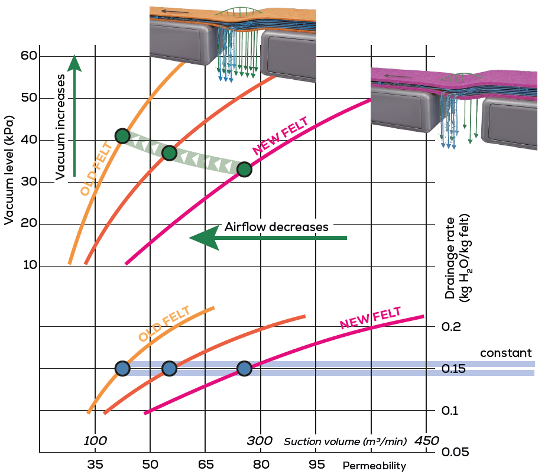
Additionally, the lower permeability and smaller air volume of an old felt have a greater effect than the expansion caused by higher vacuum. Air volume therefore decreases as the felt ages.
This relationship is therefore important when selecting a vacuum source for consistent dewatering across changing felt conditions.
Conventional systems such as liquid ring vacuum pumps provide nearly constant airflow at a given speed, while vacuum varies with system resistance. This does not match paper-machine requirements. A new, permeable felt needs high airflow at relatively low vacuum; insufficient airflow can impair dewatering and require lower machine speed. As permeability falls, the same pump continues to deliver high airflow and drives vacuum upward. Excessive vacuum increases energy use and may damage the felt at the Uhle-box slot edge without a corresponding improvement in drainage.
Operators often compensate to limit excessive vacuum and felt wear by bleeding air into the system. Although this stabilises operation, the pump no longer follows the actual process need and consumes energy handling additional air. Such systems operate efficiently only over a limited range of felt conditions and not suited to modern high-speed machines across the felt lifecycle. Frequency-controlled drives extend the volumetric range only to limited extent because airflow and vacuum remain linked.
Similarly, variable-speed centrifugal blowers offer more flexibility, but speed still changes airflow and vacuum together: reducing speed lowers both, while increasing speed raises both.
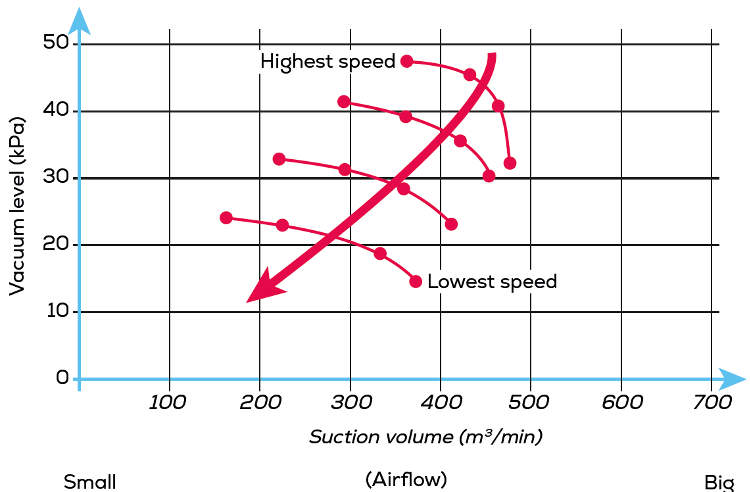
This conflicts with the requirement for lower airflow and higher vacuum as felt permeability decreases. To maintain vacuum, the blower may operate near maximum speed as the felt ages, limiting energy savings and efficient operation across changing machine speeds, production requirements and felt ages. Speed control remains useful for adjusting overall capacity. However, speed alone cannot generate the combination of reduced flow and increased vacuum demanded by an ageing felt. A wide speed-control range therefore does not necessarily provide a wide usable process range.
Clearly, independent control is therefore required: high airflow with lower vacuum for a new felt, followed by lower airflow with higher vacuum as permeability declines with ageing felt.
Everllence TURBAIR blowers achieve this decoupling with adjustable exhaust guide vanes. Vane position controls airflow, while rotational speed determines vacuum level. Together, they align blower characteristics with paper-machine requirements throughout felt life, with automatic adjustment reducing operator intervention and production slowdowns. The two actuating variables perform different functions and can be coordinated over a broader operating field than speed control alone. This allows the blower characteristic to follow the changing drainage requirement rather than one fixed relationship between airflow and vacuum.
x-head: Achieving optimal paper processes
Systems that decouple vacuum and airflow can maintain consistent dewatering across felt ages, grade changes and machine speeds. Designs coupling these variables have fewer options to respond to changing conditions.
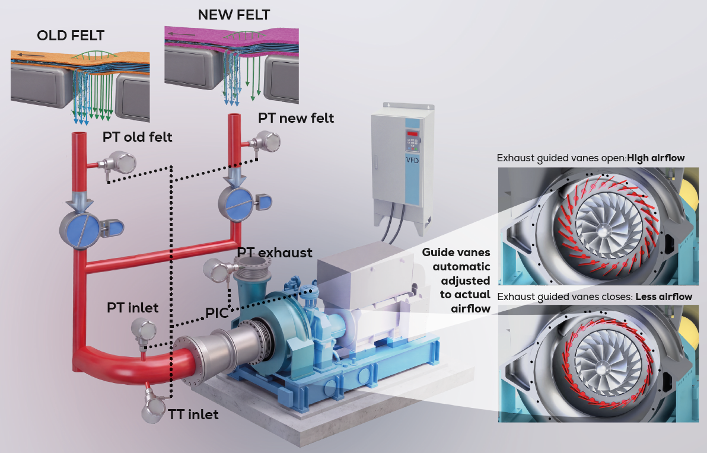
Decoupling reduces sensitivity to felt condition, the need for speed reductions and the risk of felt damage from excessive vacuum. It also allows operation to follow process requirements rather than relying on air bleeding, supporting process robustness and consistent product quality. Technologies without this capability may result in lower production rates, higher energy use or increased felt wear.
An automated TURBAIR process control system further supports consistent felt dewatering. A characteristic curve for each felt defines the relationship between age and required vacuum setpoint.
The felt-age-dependent vacuum setpoint provides the reference for calculating TURBAIR blower characteristics. Setpoint changes automatically adjust vane pitch. Dynamic pressure losses in the pipeline and water separator are also considered when determining energy-optimised speed, allowing the system to adapt to process changes, including felt replacement and the resulting higher flow requirement. The control valve at the suction point with the highest vacuum requirement remains fully open, minimising throttling losses.
Furthermore, TURBAIR control logic also uses intake temperature and exhaust back pressure as correction variables. Higher intake temperature raises the vacuum requirement, while increasing exhaust back pressure reduces available vacuum. The operating point is therefore continuously recalculated and adjusted. These corrections help maintain the required suction conditions when ambient and system conditions change, rather than relying on a fixed blower setting.
As paper machines increase in speed and productivity, the margin for error in indirect dewatering narrows. Applying the correct physical principles in vacuum system design is therefore essential for reliable & efficient papermaking with modern high-speed machines.
