
PPWR Roadmap: Europe’s Path to Less Packaging Waste
With a goal of cutting packaging waste 15 per cent by 2040, Europe is pushing companies toward packaging that can be recycled, recovered and reused more effectively.
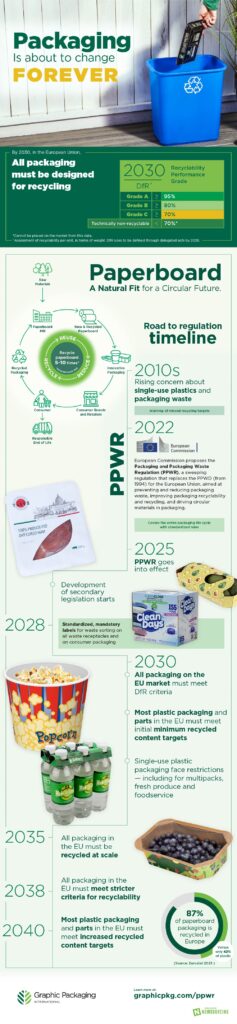
The European Union has drawn a clear line in the sand: by 2030, all packaging placed on the EU market must be designed for recycling. That deceptively simple mandate is the headline of the Packaging and Packaging Waste Regulation (PPWR), and it is already reshaping how consumer brands design, source and sell products globally.
For multinational companies, this is not just a regional regulatory change. Any packaging or packaged product sold in the EU, including imports, must meet the new requirements regardless of where it is produced. And because many global brands prefer to standardise packaging across markets, PPWR’s influence is likely to extend well beyond Europe as companies adopt compliant designs more broadly to simplify their operations.
PPWR at a Glance
At the heart of the regulation is a performance-based “Design for Recycling” (DfR) framework. Packaging will be graded A (≥95 per cent recyclable), B (≥80 per cent) or C (≥70 per cent) with anything below 70 per cent deemed “technically non-recyclable” and effectively phased out of the market by 2030. The requirements will tighten further in 2035 and 2038. This grading system turns sustainability from aspiration into a hard commercial requirement, while creating incentives for higher recyclability through lower Extended Producer Responsibility (EPR) fees.
PPWR entered into force in February 2025. Its provisions become directly applicable law across all 27 EU member states on Aug. 12, 2026, replacing the packaging directive that has governed the market for three decades. Restrictions on PFAS in food-contact packaging take hold from that date, ahead of the design-for-recycling mandate that phases in through 2030.
Why Paperboard Fits the PPWR Era
Under the new rules, the ideal packaging material must combine high recyclability, proven collection infrastructure and compatibility with recycled content targets.
Paperboard checks each one.
European systems recover approximately 87 per cent of paper and paperboard packaging, significantly outperforming plastic. This established infrastructure reduces compliance risk and simplifies the path to achieving strong recyclability performance.
Paperboard is also inherently aligned with circular design. Fibres can be recycled multiple times — often cited as 10 or more cycles[1] — enabling valuable materials to be used again.
In addition, fibre-based formats can help brands navigate tightening restrictions on certain single-use plastic packaging formats while supporting broader goals around recyclability and resource efficiency.
Looking Ahead
The PPWR sets binding packaging waste reduction targets across the EU:
- 5% by 2030
- 10% by 2035
- 15% by 2040
All reductions are measured against 2018 levels.
For consumer brands, the design-for-recycling mandate is both a constraint and an opportunity. Those who adapt early — embracing materials like paperboard and designing for circularity — will not only be better prepared for compliance but also gain a competitive edge in a market where sustainability is rapidly becoming the baseline.
[1] Graphic Packaging’s 2025 Impact Report (page 13)